
Distracted Driving Laws, Vermont







Vermont law limits how drivers may use phones and electronic devices while driving. Violations can lead to fines, license suspension, higher insurance rates, and civil claims. Knowing these rules helps drivers avoid tickets and helps injury victims understand when another driver broke the law.
Understanding Vermont Distracted Driving Laws
Vermont’s distracted driving laws apply to every driver operating a vehicle on public roads in the state. This includes residents, visitors, and commercial drivers. The rules target specific behaviors, not driver experience or age category.
Vermont law prohibits drivers from holding or manually using a portable electronic device while operating a motor vehicle on public roads.
The rule applies across Vermont and covers cars, trucks, motorcycles, and commercial vehicles.
A driver does not have to be speeding or driving recklessly to violate the law. Simply holding or operating a handheld device while the vehicle is in traffic is enough.
This includes:
- Texting
- Calling while holding the phone
- Browsing the internet
- Using social media
- Taking photos or videos
- Manually entering GPS data
Even if your vehicle is stopped at a red light, the law still applies. If you are in a lane of travel, handheld device use is prohibited.
The focus of the statute is handheld electronic device use. Other distractions may be unsafe, but Vermont’s distracted driving statute primarily targets manual phone operation.
Young drivers face stricter rules. Vermont prohibits all cell phone use for drivers under 18, even hands-free devices. This extends the law’s reach to cover teen drivers more broadly.
What Is Allowed Under Vermont Law
Vermont’s distracted driving statute does not ban all phone use. It bans the handheld use of portable electronic devices while operating a motor vehicle.
Under Vermont Statutes Annotated Title 23 §1091, drivers may use electronic devices if the use is truly hands-free.
Permitted activities include:
- Hands-free calling
- Voice-activated texting
- Voice-command features such as Siri or Google Assistant
- Navigation systems that are properly mounted
- Devices secured to the windshield or dashboard
The key requirement is simple: the device cannot be held in your hand.
A phone may be mounted to the dashboard or windshield in a fixed position. Once mounted, the driver may activate or deactivate a feature with a single touch, provided it does not require continuous manual interaction.
However, manually typing, scrolling, or holding the device while driving remains prohibited.
What Counts as “Hands-Free”?
Hands-free use means:
- The phone is mounted or integrated into the vehicle
- The driver does not hold it
- The driver does not manually type or scroll
- The interaction is minimal and voice-based
Bluetooth systems built into the vehicle are permitted. So are properly mounted third-party holders.
Holding the phone in your hand, even briefly, can still result in a citation.
Are You Allowed to Use GPS?
Yes, but only if:
- The device is mounted securely
- You do not manually enter data while driving
Entering an address while stopped in traffic may still violate the statute. Drivers should program navigation systems before putting the vehicle in motion.
Emergency Exceptions
Vermont law allows the use of handheld devices in genuine emergencies.
Examples include:
- Calling 911
- Reporting a fire
- Reporting a medical emergency
- Reporting a crime in progress
- Seeking help after a breakdown that creates a safety risk
The emergency exception is narrow. Routine calls do not qualify.
How Do Law Enforcement Officers Detect and Enforce Distracted Driving Violations?
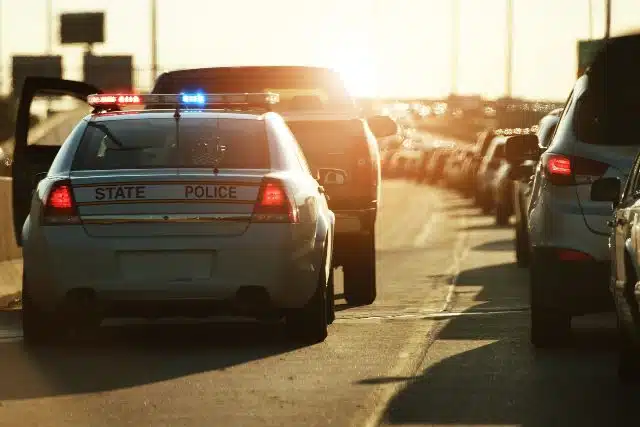
Vermont law enforcement officers primarily rely on direct observation to enforce distracted driving laws.
Because handheld device use is a visible behavior, most citations begin with what an officer sees in real time.
Visual Observation
Officers may initiate a traffic stop if they observe:
- A driver holding a phone
- A device positioned in the driver’s hand
- Repeated downward glances toward a handheld object
- Fingers actively manipulating a screen
- Swerving or drifting while looking down
The key factor is observable handheld use. Officers must see conduct that suggests the driver is manually operating a portable electronic device.
Mere suspicion is not enough. An officer must have clear, observable reasons to believe a violation occurred. This legal standard is known as probable cause.
If the officer clearly sees the device in the driver’s hand, that typically satisfies the legal threshold for a stop.
Traffic Stops and Driver Interaction
During the stop, an officer may:
- Ask whether the driver was using a phone
- Document the driver’s hand position
- Note statements made by the driver
- Record observations in a written citation
Drivers are not required to admit to using a phone. Officers also cannot search a phone without consent or a warrant.
The enforcement focus remains on what the officer personally observed.
Body camera footage and dashcam video often support the citation.
Enforcement After a Crash
Distracted driving enforcement frequently occurs during accident investigations.
If officers suspect distraction contributed to a crash, they may:
- Interview drivers and witnesses
- Review statements at the scene
- Document physical evidence
- Seek phone records if necessary
Phone records are not automatically reviewed. Law enforcement must follow legal procedures to obtain them.
If phone records show texting at the time of the crash, that evidence may support a traffic citation and strengthen a civil injury claim.
High-Visibility Enforcement Areas
Vermont State Police and local departments often increase distracted driving enforcement in:
- School zones
- High-traffic corridors
- Construction zones
- Areas with elevated crash rates
These enforcement efforts are part of broader roadway safety initiatives.
What Are the Penalties Under Vermont’s Distracted Driving Law?
Vermont uses a tiered penalty system. The more violations a driver accumulates, the more serious the consequences become.
A first distracted driving offense is treated as a civil traffic violation. The fine typically ranges between $25 and $100. While this may seem minor, the violation adds a point to the driver’s record and begins a pattern that can quickly escalate.
A second offense within two years increases the fine, generally ranging from $50 to $200. At this stage, the court may also impose a license suspension. Even a short suspension can disrupt employment, school attendance, and daily responsibilities.
A third violation within two years carries significantly higher penalties. Fines may reach $500. License suspension becomes more likely and may extend up to 30 days or longer. Additional violations within a short period can lead to longer suspensions and greater financial consequences.
Points accumulate under Vermont’s DMV system. Six points within a 12-month period can trigger suspension.
Distracted driving violations stay on your record for several years. Repeat tickets increase the risk of suspension and higher insurance costs.
License Suspension and Driving Privileges
License suspension is one of the most disruptive consequences of repeat violations.
A suspended license means the driver cannot legally operate any motor vehicle during the suspension period. Reinstatement typically requires payment of additional fees and compliance with DMV requirements.
For commercial driver’s license (CDL) holders, the stakes are higher. Federal rules also ban texting and handheld phone use in commercial vehicles.
A single violation can result in disqualification from operating a commercial vehicle.
Multiple violations within three years can lead to long-term or permanent loss of commercial driving privileges.
For drivers who depend on a CDL for employment, this consequence can effectively end a career.
Insurance Consequences
Insurance companies view distracted driving as risky behavior.
After a conviction, premiums often increase between 10 and 25 percent. In some cases, the increase is higher, especially if the driver has prior violations.
These rate increases typically last three to five years. Over time, the total added cost can far exceed the original fine.
Some insurers may decline to renew coverage after repeated violations, making it more difficult and expensive to obtain new insurance.
Employment and Professional Impact
Distracted driving violations appear on a driving record maintained by the Vermont Department of Motor Vehicles.
Employers that require driving as part of the job may review this record. Transportation companies, delivery services, and commercial fleets often maintain strict policies regarding device use violations.
Professional license holders in regulated fields may also face review if the violation reflects unsafe conduct.
Even when a violation is classified as civil, its practical impact can extend beyond traffic court.
Civil Liability After a Distracted Driving Crash
If distracted driving causes a crash, the financial exposure increases dramatically.
In civil court, proof that a driver used a phone can help show negligence. Phone records, officer testimony, and witness statements may be used to establish that the driver breached a duty of care.
This can result in liability for:
- Medical expenses
- Lost wages
- Property damage
- Pain and suffering
- Long-term disability
The civil consequences often exceed the statutory traffic penalties.
Why Legal Support Matters
If you were injured in a crash involving distracted driving, speaking with an experienced car accident attorney can make a meaningful difference.
A lawyer can review police reports, check phone records, protect evidence, and determine whether the violation strengthens your injury case.
The team at Sabbeth Law helps clients throughout Vermont understand their options and pursue compensation when another driver’s distraction causes harm.
Frequently Asked Questions
Can I use my phone at a red light in Vermont?
No. A red light is still considered driving. Holding or using a phone while stopped in traffic is a violation.
Can police search my phone during a traffic stop?
Not without consent or a warrant. You are not required to unlock or hand over your phone unless legally ordered.
Does eating or adjusting the radio count as distracted driving?
Those actions may be unsafe but are not specifically banned under Vermont’s handheld device statute. However, if they cause unsafe driving, other traffic laws may apply.
Will a distracted driving ticket affect my insurance?
Yes. Most insurers increase premiums after a conviction. The increase often lasts several years.
Can distracted driving be used against me in a personal injury lawsuit?
Yes. If you were using a phone at the time of a crash, that evidence may be used to show negligence.
Client Testimonials
“Immediately after my son’s injury at work, he was treated poorly. Over the course of the next few days it became even worse, so I called Mike and he and Crystal have been absolute lifesavers during the process. Mike is not your typical stuffed suit lawyer who only cares about the bottom line he genuinely cares about his clients and his assistant Crystal is beyond amazing! My thanks to you both!”
LUKE PARMENTER
“I could never ask for a better attorney, to fight for me, to believe in me, and have faith in me, than what I found in Mike Sabbeth, He doesn’t treat you like a client, he treats you as if you are one of his own family members, He will fight for you, with all he has, and is ALWAYS up front and honest with you about everything!”
SANDRA DRUGE